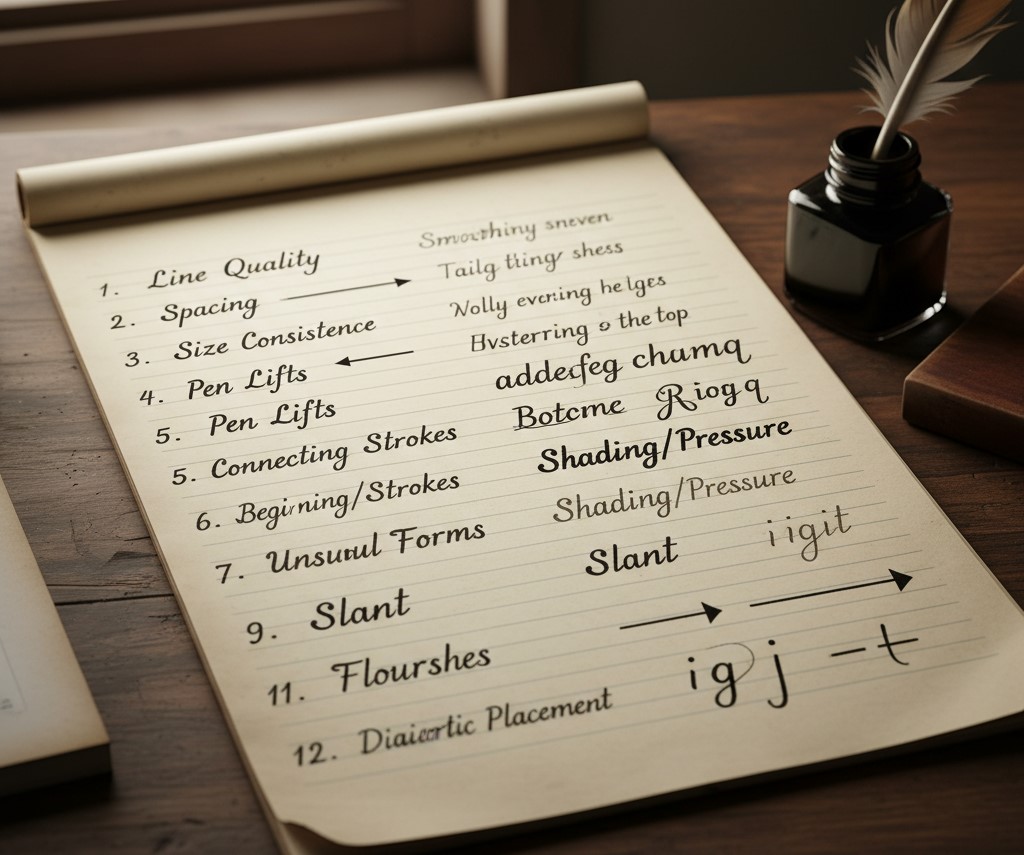
In the world of forensic science and graphology, experts use a standardized set of criteria to compare samples and identify the writer. These 12 handwriting characteristics act as a “biometric” signature that is nearly impossible to perfectly forge.
Below, we break down each of these key traits used to differentiate one person’s writing from another.
1. Line Quality
Line quality refers to the flow and thickness of the letters. Are the lines smooth and fluid, suggesting a fast, confident writer? Or are they shaky and irregular, which might indicate a forgery, old age, or extreme nervousness?
2. Spacing of Words and Letters
This characteristic examines the average amount of space left between words and between individual letters. Consistency is key here; most people have a habitual “buffer” they maintain throughout a page.
3. Size Consistency
Experts look at the ratio of height to width in each letter. Does the writer maintain a steady height for their lowercase letters (like ‘a’ and ‘o’) compared to their tall letters (like ‘t’ and ‘l’)?
4. Pen Lifts and Continuity
Do you lift your pen between every letter, or do you write in a continuous, flowing motion? Forgers often struggle with this, adding unnatural pen lifts where a natural writer would have kept the pen on the paper.
5. Connecting Strokes
This refers to how capital letters are joined to lowercase letters, or how letters within a word are linked. For example, does the stroke from an ‘o’ connect to the next letter from the top or the bottom?
6. Beginning and Ending Strokes
Every word has a “start” and a “finish.” Analysts look at whether these strokes are blunt, curled, or flourished. Some people start with a small “hook,” while others end with a long, tapering line.
7. Unusual Letter Formation
We all have “quirks”—perhaps a uniquely shaped ‘q’ or a figure-eight ‘s’. These idiosyncratic formations are like a personal trademark that is difficult for others to replicate.
8. Shading and Pen Pressure
Pressure analysis looks at how hard the writer presses down. This is usually visible by how thick or dark the ink appears on the page. Heavy pressure often indicates a high-energy or intense personality, while light pressure may suggest sensitivity.
9. Slant or Inclination
Which way do your letters lean? A right slant is the most common, but a left slant or a perfectly vertical orientation can tell a different story about the writer’s emotional state or social orientation.
10. Baseline Habits
Does your writing stay perfectly on the line, or does it tend to float above it or dip below it? Following an imaginary baseline is a strong habit that remains consistent even when writing on unlined paper.
11. Flourishes and Embellishments
Do you add extra loops to your ‘g’s or ‘j’s? These decorative elements are non-essential to the letter’s legibility but are highly essential to the writer’s unique style.
12. Diacritic Placement (Dots and Crosses)
Finally, the way you “cross your t’s and dot your i’s” is a major identifier. Is the ‘t’ cross high or low? Is the ‘i’ dot a precise point, a circle, or a dash? This is often the most overlooked but revealing characteristic.
Analyze Your Own Penmanship Today
Now that you know the 12 major characteristics of handwriting, why not put them to the test? Your handwriting is a window into your subconscious, revealing traits about your confidence, social style, and attention to detail.
Ready to see what your script says about you?
Perform your own online handwriting analysis here!