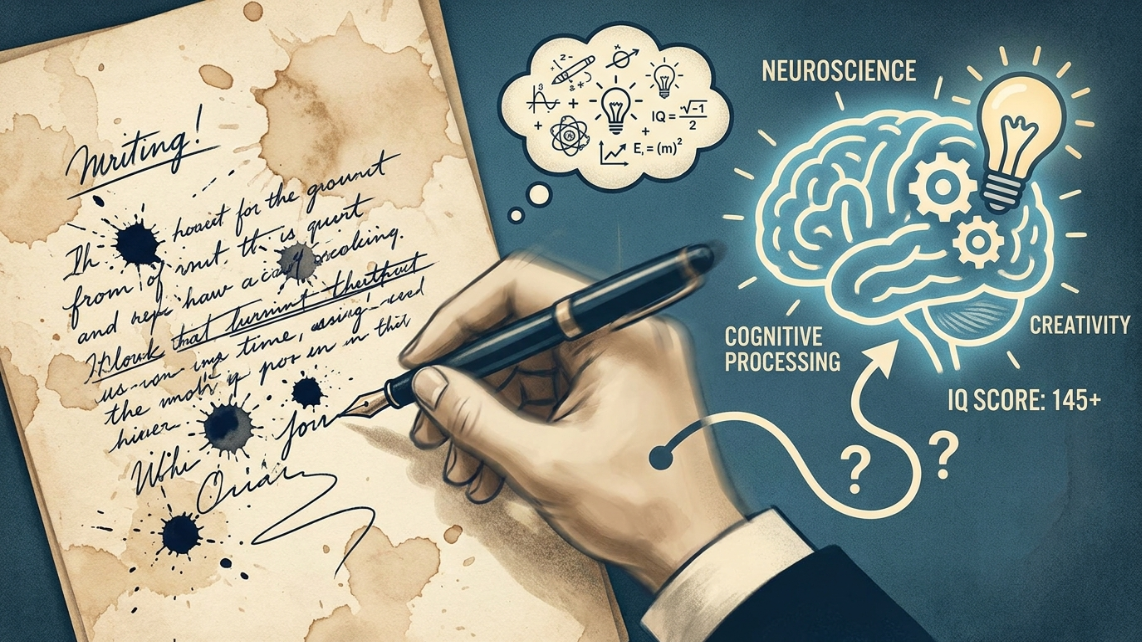
For decades, students have been scolded for messy notebooks, and doctors have been teased for illegible prescriptions. However, a persistent cultural theory suggests that a “scrawly” hand might actually be the mark of a brilliant mind. But is there any truth to the claim? Is bad handwriting linked to higher IQ? What science says might surprise you.
The Theory of Cognitive Speed
One of the most common scientific explanations for the link between intelligence and poor penmanship is the “efficiency of thought.” Researchers suggest that individuals with high IQs often experience a cognitive “bottleneck.” Their brains process information and generate ideas at a speed that their physical motor skills simply cannot match.
When the mind is racing ahead, the hand prioritizes capturing the idea over the aesthetics of the letterforms. This results in what graphologists call “speedy handwriting,” where letters may become simplified or “threaded” (looking like a wavy line) to maintain the flow of thought.
What Science Says: Research on Handwriting and Intelligence
When looking at what science says about messy handwriting and IQ, the evidence is nuanced. While many believe it is a definitive sign of genius, psychological studies offer a more complex view:
- Neural Efficiency: Some neuroimaging studies suggest that while proficient handwriting is linked to certain literacy developments in children, “messy” handwriting in adults can sometimes indicate a focus on high-level conceptualization rather than rote motor tasks.
- The “Methodically Uneven” Trait: In the world of graphology, certain types of “bad” writing—specifically those that are uneven but maintain a distinct rhythm—are often categorized as signs of original and creative thinking.
- Dysgraphia vs. Intelligence: It is important to distinguish between “messy” writing and dysgraphia. Many famous geniuses, including Albert Einstein and Thomas Edison, struggled with dysgraphia (a learning disability affecting writing), proving that academic “deficits” in penmanship do not limit intellectual potential.
Famous Geniuses with “Bad” Handwriting
History is filled with brilliant minds whose signatures and notes were notoriously difficult to decipher. If you struggle with legibility, you are in good company:
- Albert Einstein: Known for his complex theories, his handwriting was often small and dense.
- Napoleon Bonaparte: His handwriting reportedly became more illegible as his stress and the speed of his life increased.
- Pablo Picasso: The master of modern art had a scrawl that defied conventional standards, reflecting a mind in constant creative overdrive.
- Isaac Newton: His scientific journals are a testament to rapid-fire thought, often featuring cramped and hurried script.
Is Messy Handwriting a Sign of Intelligence?
While “bad” handwriting isn’t a guarantee of a high IQ, certain types of illegibility are more telling than others. For instance, if your writing is messy because you are combining letters to write faster, it demonstrates “comprehensive thinking”—the ability to make swift decisions and evaluate plans on the fly.
On the other hand, purely “undeveloped” handwriting may point to a lack of motor practice. The key is in the flow; “intelligent” messiness usually retains a sense of energy and purpose.
Discover Your Own Handwriting Personality
Your penmanship is more than just a way to take notes—it is a “brain-print” that reveals unique facets of your personality and cognitive style. Are you a fast-thinking visionary or a meticulous analyst?
Take the next step and perform your own online handwriting analysis to uncover what your script says about you.