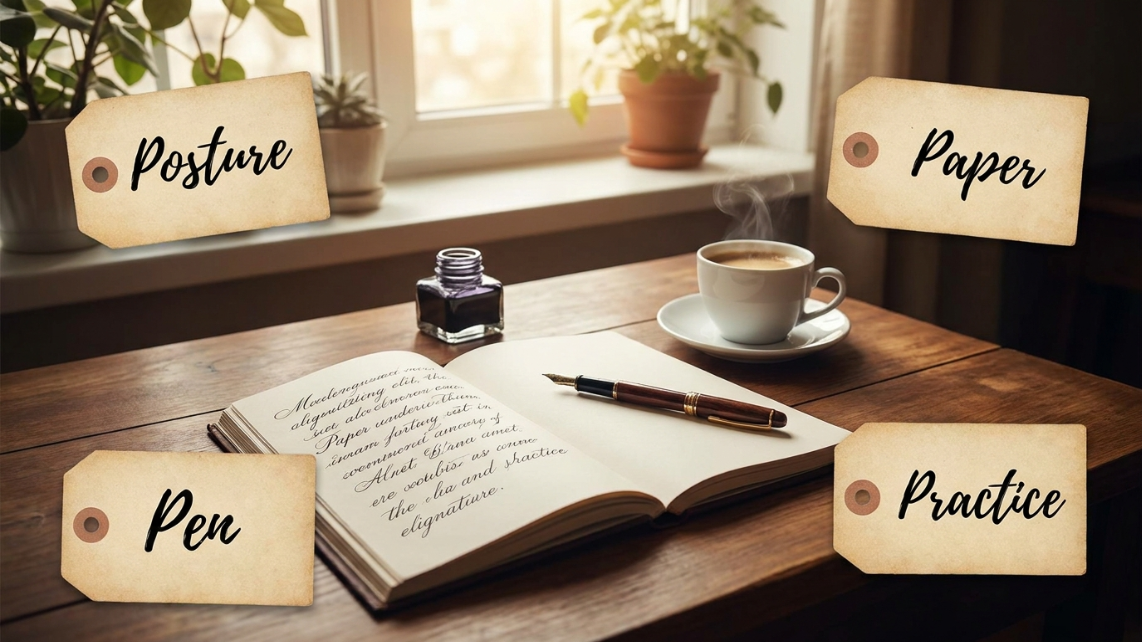
What Are the 4 P’s of Handwriting?
Whether you are a parent helping a child develop fine motor skills or an adult looking to refine your signature, understanding the fundamentals is key. Most educators and occupational therapists point to a specific framework known as the 4 P’s of Handwriting.
These four pillars—Posture, Paper, Pencil, and Practice—form the foundation of legible, fluid, and pain-free writing. By optimizing each of these areas, you can transform messy scribbles into a polished script.
1. Posture: The Foundation of Control
Before the pen even touches the page, your body must be positioned correctly. Poor posture leads to quick fatigue and “writer’s cramp.”
- Feet: Should be flat on the floor to provide a stable base.
- Back: Sit upright with a slight forward lean, but avoid slouching over the desk.
- Arms: Both forearms should rest comfortably on the table. The non-writing hand acts as an “anchor” to hold the paper steady.
2. Paper Position: Finding the Right Angle
A common mistake is keeping the paper perfectly vertical. For the most natural movement of the wrist, the paper should be slanted:
- Right-handed writers: Slant the top-right corner of the paper upward.
- Left-handed writers: Slant the top-left corner upward to avoid “hooking” the wrist and smudging ink.
Proper paper placement allows the writing arm to move in an arc across the page without restricted movement.
3. Pencil Grip: The Mechanics of Writing
The “Pencil” pillar focuses on how you hold your writing utensil. The gold standard is the Tripod Grip, where the pencil is held between the thumb and index finger, resting on the middle finger.
- Pressure: Don’t grip too hard! If your knuckles are white, you’re applying too much tension.
- Tools: For beginners, triangular pencils or rubber grips can help establish the correct finger placement.
4. Practice: Consistency Over Intensity
The final “P” is Practice. Handwriting is a muscle memory task. Instead of practicing for hours once a week, aim for 10 to 15 minutes of focused effort daily. Focus on:
- Letter formation: Starting at the top of the letter.
- Spacing: Keeping consistent gaps between words.
- Sizing: Ensuring tall letters and short letters are proportional.
Analyzing Your Penmanship
Now that you understand the foundational elements of handwriting, you might be wondering how your current style stacks up. Identifying specific habits in your slant, pressure, and letter connections can provide deep insights into your writing mechanics.
Get a Professional Handwriting Analysis
Are you curious about what your handwriting says about your technique or personality? You don’t have to guess.
Analyze your script today: Head over to Handwriting Analysis to perform your own online handwriting analysis and get instant feedback on your unique style.
By mastering the 4 P’s and using modern analysis tools, you can achieve a level of penmanship that is both beautiful and functional.