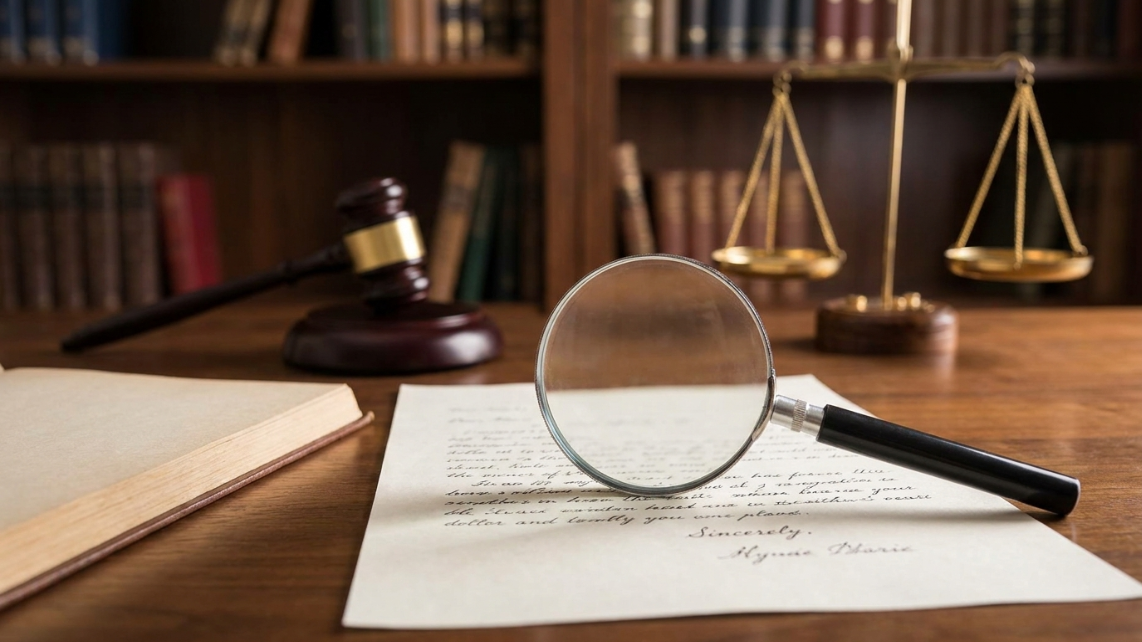
In the world of forensic science, few topics spark as much debate as handwriting analysis. Whether it’s a disputed will, a forged check, or a ransom note, the question often arises: can a person’s unique script really be used to prove a case?
If you have ever wondered, “How does handwriting analysis hold up in court?” the answer is a complex blend of historical precedent, evolving legal standards, and the rigorous discipline of Questioned Document Examination (QDE).
The Admissibility of Handwriting Evidence
The short answer is yes, handwriting analysis is generally admissible in court, but it is not a “magic bullet.” Unlike DNA, which has a near-zero error rate when handled correctly, handwriting analysis is considered a subjective science.
For handwriting evidence to be admitted, it must typically pass one of two legal tests depending on the jurisdiction:
- The Daubert Standard: Used in federal and many state courts, this requires that the expert’s methods be peer-reviewed, testable, and have a known error rate.
- The Frye Standard: Used in other states, this focuses on whether the technique is “generally accepted” within the scientific community.
Is Handwriting Analysis Legally Reliable?
When questioning how handwriting analysis holds up in legal proceedings, the focus often shifts from “admissibility” to “weight.” A judge may allow the evidence, but it is up to the jury to decide how much they believe it.
To ensure reliability, professional Forensic Document Examiners look for “individualizing characteristics,” such as:
- Line Quality: Is the writing smooth or shaky (suggesting a slow, deliberate forgery)?
- Slant and Pressure: The consistent angle and the force applied to the paper.
- Letter Formation: Unique ways of looping “y’s” or crossing “t’s.”
Challenges to Admissibility
Critics often argue that handwriting analysis is “junk science” because it relies on the expert’s interpretation. To counter this, experts must provide exemplars—confirmed samples of the person’s writing—to show a clear pattern of habits that match or deviate from the questioned document.+1
The Difference Between Graphology and Forensic Examination
It is vital to distinguish between Graphology (personality assessment through writing) and Forensic Document Examination. While graphology is rarely accepted in criminal trials, QDE is a recognized forensic pillar used by the FBI and Scotland Yard.
If you are interested in the more personal side of writing—discovering what your loops and slants say about your character—you can explore the psychological aspects through modern digital tools.
Analyze Your Own Writing: Want to see what your penmanship reveals? You can perform your own online handwriting analysis to get instant insights into your unique writing style.
How Handwriting Analysis Holds Up in Court Today
In 2026, the digital age has changed the game. While we write fewer physical letters, the “digital footprint” of a signature on a tablet or a stylus-signed contract still falls under the purview of handwriting experts.
The consensus remains: while handwriting analysis is not infallible, when presented by a qualified professional with sufficient evidence (exemplars), it remains a powerful tool in the courtroom. It often serves as the “corroborating evidence” that tips the scales of justice in fraud and forgery cases.